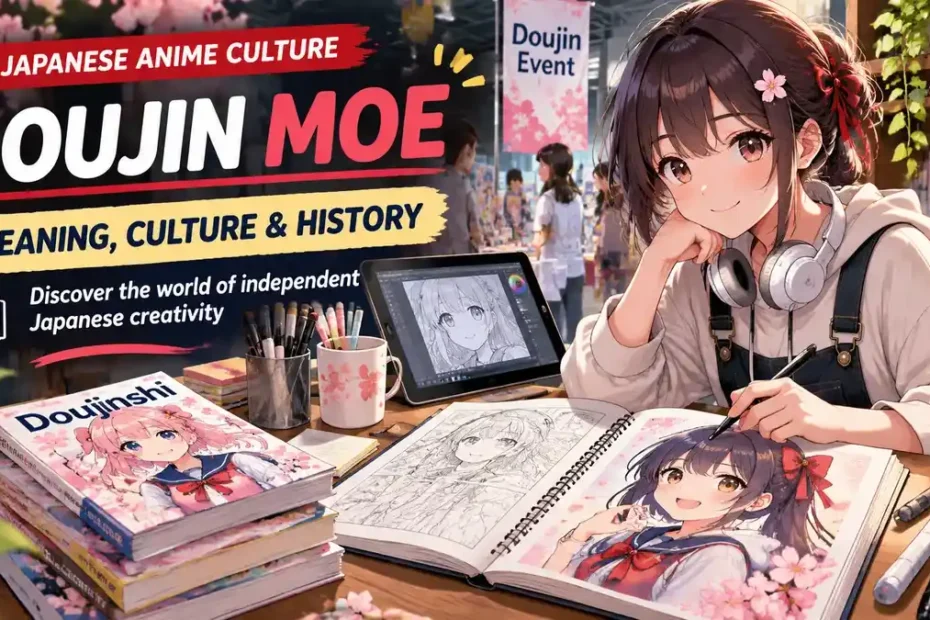
Searching for Doujin Moe can lead to mixed explanations: some pages describe a Japanese fan-culture idea, while others use the name for a specific online service. That confusion matters because a familiar label does not prove that a site is official, safe, or authorized to share the work it displays. This guide separates the cultural terms from unverified website claims and shows readers how to check sources, copyright, and creator information before acting.
Quick Answer: What Is Doujin Moe?
Doujin Moe is a search phrase associated with Japanese doujin culture and the appeal of anime and manga characters. It combines two distinct concepts: doujin, which relates to independent or self-published creative works, and moe, which describes an emotional response of affection or attachment.
The phrase can also appear as the name of an online platform in historical references. However, the two cultural concepts should not be confused with the identity or current status of a particular website.
What Does Doujin Moe Mean?
To understand the expression, it helps to examine its two parts separately.
Doujin (同人) refers to people who share interests, creative goals, or artistic communities. In modern Japanese popular culture, the term is strongly associated with independent publishing and fan-created works.
Moe (萌え) describes a feeling of affection, excitement, or emotional attachment toward a character or something that creates a strong positive response.
When combined, the phrase suggests a connection between independently produced Japanese creative works and the emotional appeal of fictional characters.
However, Doujin Moe is not a standardized publishing category. Its meaning depends on the context in which someone uses it.
Doujin, Doujinshi, and Moe: What’s the Difference?
These three terms are related, but they do not mean the same thing.
| Term | Meaning | Main Association |
|---|---|---|
| Doujin | People sharing creative interests | Independent communities |
| Doujinshi | Self-published creative publications | Manga, stories, illustrations |
| Moe | Emotional affection or attachment | Character appeal |
| Fan art | Artwork inspired by existing media | Visual creativity |
| Fan fiction | Stories inspired by existing fictional worlds | Creative writing |
| Original doujin work | Independently created material | Individual artistic expression |
| Doujin circle | An individual or group producing creative works | Independent publishing |
The Comic Market Preparations Committee explains that doujinshi originally developed as publications created by people with shared interests. Individual creators also became an important part of this publishing culture as production became more accessible.
This distinction helps readers understand the difference between a creative format, a community, and an emotional concept.
Is Doujin Moe a Website, a Genre, or a General Search Phrase?
The answer depends on the context.
People may encounter the expression in discussions about Japanese fan publications, anime illustrations, independent manga, or online content platforms.
Some historical online references also use Doujin Moe as a website name. However, a website using a particular name does not automatically represent the wider doujin community.
It is important to distinguish three things:
- Cultural meaning: The relationship between independent Japanese creative work and character-focused appeal.
- Online platform references: Websites or services that have used a similar name.
- Search terminology: Words people enter into search engines to locate information, artwork, or publications.
The primary cultural sources discussed in this article do not establish Doujin Moe as an official genre, publishing organization, or recognized industry classification.
Readers should verify a website’s ownership and identity independently rather than assuming that every matching domain is connected to an original service.
How Did Japanese Doujinshi Culture Develop?
Japanese doujinshi culture developed from independent creative communities in which people published and shared their own work.
Its roots extend beyond modern anime and manga. Earlier publications included literature, academic writing, criticism, and artistic expression.
As printing became more accessible, individuals and small groups gained greater opportunities to publish their own material.
The Comic Market, widely known as Comiket, became an important meeting place for these creators and their audiences. Its first event took place in 1975, providing a space for independent creative exchange.
Over time, the community expanded to include:
- Self-published manga and comics.
- Original illustrations and art collections.
- Independent novels and short stories.
- Fan-created publications.
- Music and independent games.
- Creative works connected to anime and video games.
Today, doujin culture represents a broad creative ecosystem rather than one particular website or artistic style.
The official Comic Market historical overview provides useful background on the development of this publishing community.
What Types of Works Are Associated With Doujin Culture?
Independent publishing gives artists considerable freedom to explore different formats and subjects.
The following table explains some common categories.
| Category | Description | Example |
|---|---|---|
| Original manga | Stories created independently | A new fantasy comic |
| Fan manga | Stories inspired by existing media | An unofficial story based on an anime |
| Illustration books | Collections of original artwork | Character design collections |
| Doujin novels | Independently published fiction | Short fantasy stories |
| Art collections | Selected creative illustrations | Digital or printed portfolios |
| Independent games | Games developed outside major studios | Small visual novels |
| Fan publications | Community-created publications | Event-exclusive magazines |
| Creative music | Independently produced compositions | Original game-inspired music |
Not every independent publication contains fan material. Many creators produce completely original characters, settings, and stories.
This variety is one of the most important aspects of Japanese independent publishing.
What Does Moe Mean in Anime and Manga?
Moe is closely connected to the emotional relationship between audiences and fictional characters.
A character may create a strong positive response because of personality, appearance, behavior, expressions, or the way the story presents them.
For example, readers might feel emotionally attached to a character because that character is:
- Kind and supportive.
- Shy or socially awkward.
- Brave despite personal difficulties.
- Funny and expressive.
- Loyal to friends.
- Emotionally relatable.
Moe is not simply another word for attractive artwork. It can involve a deeper emotional response.
A 2013 research paper by Norika Matsubara and Tatsuya Sato at Ritsumeikan University examined the concept from the perspectives of emotion, value, and the object of affection. The researchers identified positive feelings such as attachment, excitement, and affection, while also explaining that the concept does not have one simple empirical definition.
This research provides a more thoughtful understanding of the term than treating it as a fixed visual style.
Why Do People Still Search for Doujin Moe?
People searching for Doujin Moe may have different questions.
Some want to understand the cultural expression. Others may be looking for an older website, a particular publication, a creator, or information about an online service.
These different intentions explain why search results can sometimes provide inconsistent information.
The most common reasons include:
1. Understanding the terminology
Newcomers may encounter Japanese words such as doujinshi, moe, otaku, and manga without knowing how they relate.
2. Finding independent artwork
Anime fans may want to discover illustrations, original stories, and publications produced outside traditional publishing companies.
3. Researching an older platform
Some searches are navigational. Users may remember a website and want to understand whether it still exists or has an official successor.
4. Checking online safety
Readers may want to know whether a website is genuine, whether its content is authorized, and whether it protects personal information.
5. Exploring Japanese fan communities
People interested in Japanese pop culture may want to learn about independent artists, creative circles, and community publishing events.
Understanding the searcher’s actual question is more useful than assuming that everyone searching the same phrase wants the same thing.
What Can Be Verified About the Doujin Moe Website?
When researching a website with this name, separate historical references from independently verified information.
The available primary cultural sources establish the meaning and background of doujinshi and moe. They do not establish the current operator, ownership, active catalog, or official successor of a website using this particular name.
This means readers should be careful with claims about:
- Whether an original website is currently operating.
- Whether a particular domain is officially connected to it.
- Whether an alternative address is an authorized mirror.
- Whether an application is officially supported.
- Whether uploaded publications have creator permission.
- Whether an online service has changed ownership.
A website’s appearance, familiar logo, or matching name cannot independently establish authenticity.
Before trusting any online service, look for a verifiable operator, official contact information, transparent policies, and confirmation from the original creator or organization.
How to Read Common Doujin Moe Search Variations
Different search modifiers can reveal what users are trying to find.
However, a search phrase is not proof that a particular product, platform, person, or service exists.
| Search Variation | Possible Search Intent | What Readers Should Verify |
|---|---|---|
| doujin moe us | A location-specific result or alternative website address | Official ownership and domain affiliation |
| doujin moe app | Mobile access | Verified application developer |
| doujin moe urakan | A name or account association | Original creator attribution |
| free doujin moe | Free publications or online access | Creator-approved distribution |
| doujin moe website | Information about an online platform | Current operator and authenticity |
| doujin moe manga | Manga-related publications | Original publisher and content source |
| doujin moe anime | Anime-related artwork | Creator credits and publication status |
| doujin moe alternatives | Other ways to discover independent publications | Authorized distribution and privacy policies |
These variations can help a publisher organize related content into a useful topical cluster.
For example, an article about doujinshi culture can link to separate guides about independent manga, fan art, Japanese publishing events, copyright, and creator communities.
That approach gives readers a clearer path to related information without repeating the same explanation across multiple pages.
Can You Read Doujinshi Legally After Searching for Doujin Moe?
Yes. Readers can explore independent publications through channels that have permission to distribute the work.
However, it is important to understand that independent publishing does not automatically remove copyright protection.
There are two major categories:
Original publications
These contain stories, characters, illustrations, and other material created independently by the artist or publishing circle.
Derivative fan publications
These use characters, settings, or other protected elements from existing anime, manga, games, or other creative properties.
The legal treatment of derivative works depends on the applicable copyright rules, permissions, exceptions, and circumstances.
Japan’s Agency for Cultural Affairs explains that publishing derivative works, including fan art, online generally requires permission from the relevant rights holder, even when the activity is non-commercial. It also encourages users to check published creator guidelines.
Copyright rules differ between countries, so Japanese guidance should not be treated as universal legal advice.
How to Check Whether a Doujinshi Website Is Safe
A website should provide enough information for visitors to understand who operates it and how it handles content.
Before creating an account, making a payment, or downloading a file, use this checklist:
- Verify the domain: Check the spelling and avoid unfamiliar addresses that imitate established services.
- Identify the operator: Look for a genuine organization or creator with clear contact information.
- Read the privacy policy: Understand what personal information the service collects.
- Check content permissions: Look for evidence that the publisher or creator authorized distribution.
- Review age restrictions: Follow applicable age requirements and content ratings.
- Avoid suspicious downloads: Do not install unfamiliar applications, extensions, or executable files just to view a publication.
- Check payment transparency: Understand the price, billing terms, and refund policy before paying.
- Watch for misleading advertisements: Leave pages that use fake security warnings or deceptive download buttons.
A professional-looking website is not automatically trustworthy. Independent verification matters more than design.
Where Can You Find Creator-Approved Doujinshi?
Readers who want to support independent Japanese artists should prioritize original creator channels and authorized publishers.
Useful starting points include:
- Official creator websites and portfolios.
- Artist-approved digital storefronts.
- Official event catalogs and participating circles.
- Authorized digital publishing platforms.
- Publisher-approved translations.
- Creator-released sample chapters and previews.
- Independent art exhibitions and community events.
When purchasing a publication, check the circle name, artist credit, publication description, language, format, and audience rating.
These details help readers identify the actual creator and understand what they are purchasing.
Supporting artists directly also helps independent creators continue producing new publications.
How Can Independent Artists Publish Their Own Doujinshi?
Independent publishing is not limited to established illustrators or professional manga creators.
Artists can start with a small project and develop their publishing skills over time.
A practical publishing process includes:
- Develop an original concept or story.
- Create characters and establish the visual style.
- Prepare the illustrations or manuscript.
- Edit the content and check its presentation.
- Choose digital or printed publication.
- Prepare a cover, description, and creator information.
- Select a suitable distribution channel.
- Set appropriate pricing and audience restrictions.
- Promote the work through official creator profiles.
- Maintain clear copyright and usage information.
Creators working with existing characters should also review the relevant rights-holder guidelines before publishing.
The strongest independent publications combine creative originality, clear attribution, and respect for other people’s intellectual property.
Frequently Asked Questions About Doujin Culture
1. What does Doujin Moe mean?
It is a phrase associated with independent Japanese creative publications and the emotional appeal of fictional characters. It is not an established formal publishing classification.
2. Is doujinshi the same as manga?
No. Manga refers to a comic format or medium, while doujinshi refers to independently published creative works. Many doujinshi are manga, but the category also includes novels, illustrations, and other publications.
3. Is every doujinshi adult content?
No. Doujinshi covers many subjects and audiences, including comedy, fantasy, drama, romance, original fiction, and age-restricted material. Always check the publication’s rating and description.
4. Is the original Doujin Moe website still available?
Its current official operating status, ownership, and any authorized successor could not be established through the primary sources reviewed for this guide. Treat websites claiming to be official versions cautiously until their affiliation is verified.
5. Can independent artists sell fan-made manga?
That depends on copyright permissions, applicable exceptions, rights-holder guidelines, and the laws of the relevant country. Artists should check the original property’s usage rules before commercial distribution.
6. How can readers support Japanese doujin artists?
Readers can purchase authorized publications, follow official artist profiles, attend independent publishing events, share creator-approved links, and respect individual distribution and reproduction rules.
Final Thoughts: Understand the Culture, Respect the Creators
Japanese independent publishing represents a creative culture that extends far beyond any single online platform. It brings together artists, writers, illustrators, fans, and independent publishing communities.
Understanding Doujin Moe requires looking beyond the search phrase itself. Readers should recognize the difference between doujinshi, moe, fan-created material, and individual websites.
The best way to explore this subject is to seek reliable information, verify online services, respect copyright, and support the people who create the work.
Whether you are a manga enthusiast, an independent artist, or someone discovering Japanese fan culture for the first time, informed decisions help keep creative communities accessible and sustainable.
Start by exploring an authorized publication, learning about an independent artist, or discovering the history of Comiket. Every meaningful connection between a reader and a creator helps independent art continue to grow.