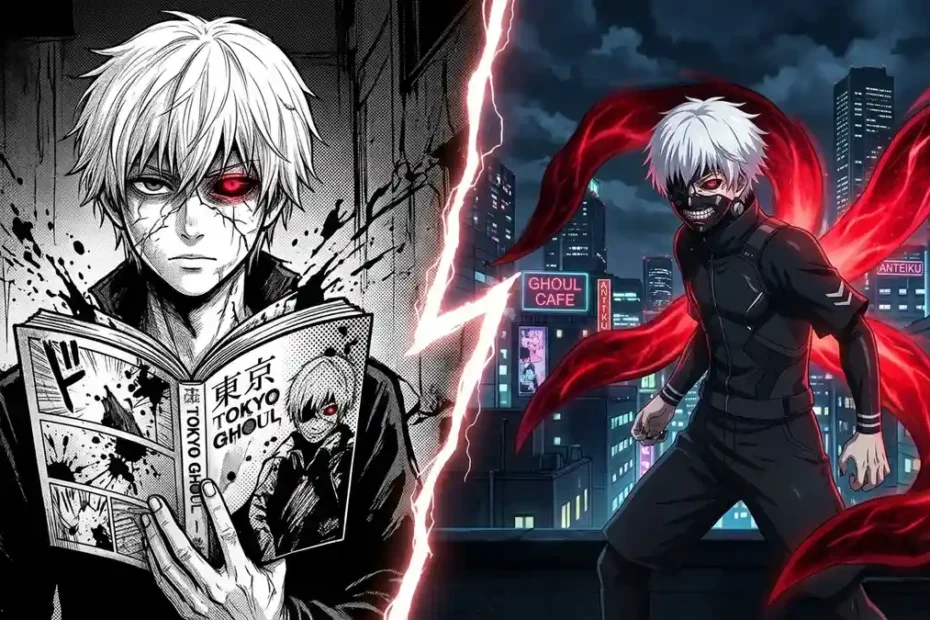
You finished the anime, and fans keep telling you the manga is better. Now you wonder what you missed. The plot splits, scenes vanish, and nobody agrees on where to start. This guide covers the Tokyo Ghoul manga vs anime differences that matter, in plain words, so you can choose your next step in minutes.
What Are the Tokyo Ghoul Manga vs Anime Differences at a Glance?
The manga tells the full story. The anime tells part of it, then changes course. Here are the main Tokyo Ghoul manga vs anime differences in one list:
- Story length: The manga runs 30 volumes. The anime covers only a slice of them.
- Plot: Tokyo Ghoul √A leaves the manga and tells its own story.
- Violence: The manga shows every panel Sui Ishida drew. The TV anime hides much of it.
- Pacing: The manga lets scenes breathe. The anime rushes from fight to fight.
- Ending: The manga closes Kaneki’s journey. The anime stops before the finale.
Short answer: Read the manga for the complete story. Watch the anime for a fast, moody introduction with great music.
Where Does Tokyo Ghoul Come From?
Sui Ishida wrote and drew Tokyo Ghoul for Shueisha’s Weekly Young Jump. The original series ran from 2011 to 2014 and filled 14 volumes. The sequel, Tokyo Ghoul:re, ran from 2014 to 2018 and filled 16 more. VIZ Media publishes both in English.
Studio Pierrot made the anime. Season 1 aired in 2014, √A followed in 2015, and two seasons of :re arrived in 2018.
Knowing who made each version explains many Tokyo Ghoul manga vs anime differences. Ishida controlled every page of the manga. A studio team had to squeeze his story into 12-episode seasons.
How Much of the Manga Does the Anime Cover?
The anime splits into three parts. Each one treats the manga differently:
- Tokyo Ghoul (2014, 12 episodes): Adapts the opening arcs and ends with Kaneki’s torture and transformation.
- Tokyo Ghoul √A (2015, 12 episodes): Follows an original plot after season 1.
- Tokyo Ghoul:re (2018, two seasons of 12 episodes): Adapts the sequel manga but skips large sections.
Add all four seasons together, and big parts of the 30-volume manga never reach the screen.
Why Does Tokyo Ghoul √A Break From the Manga?
√A starts where season 1 stops. The manga keeps following Kaneki, Anteiku and the Aogiri Tree along one path. The anime rewrites events, character choices and the finale.
This rewrite is the largest of all the Tokyo Ghoul manga vs anime differences. Battles happen in different places, and key fights end in different ways. The Anteiku conflict plays out on its own terms.
The result: √A is an alternate version, not part of the manga’s story. If you read on after watching it, you will meet many scenes you have never seen.
What Does the Anime Cut or Rush?
Season 1 packs many chapters into 12 episodes. The writers kept the big moments and trimmed the rest.
The anime shortens:
- Quiet days at Anteiku, where Kaneki learns what ghoul life feels like
- Side-character backstories
- Kaneki’s inner monologue, which drives much of the manga’s horror
- The slow build between fights
Pacing creates many Tokyo Ghoul manga vs anime differences. The manga lets a threat simmer for chapters. The anime hurries to the next clash.
How Does Censorship Change What You See?
The TV broadcast hid its goriest scenes behind darkness and shadow. Home-video releases show more.
The manga carries no such filter. Ishida’s body horror lands exactly as he drew it. Cannibalism, injuries and torture feel heavier on the page.
Censorship is among the most visible Tokyo Ghoul manga vs anime differences. If you watched the broadcast version, you saw a softened cut.
How Do the Characters Differ?
The cast stays the same, but their depth does not. The manga gives each person more room.
- Kaneki Ken: The manga lingers in his mind. His change from shy student to hardened fighter feels earned.
- Touka Kirishima: The manga builds her story over more chapters, which makes her bond with Kaneki hit harder.
- Hide Nagachika: His role grows much bigger in the manga’s later arcs.
- Kishou Arima: The manga gives the CCG’s top investigator more weight and mystery.
Character depth is where the Tokyo Ghoul manga vs anime differences feel personal.
How Do the Art and Storytelling Differ?
Ishida’s pages use dense linework, cracked-mirror panels and haunting close-ups. You read at your own speed, and you can stare at a single panel as long as you like.
The anime counters with color, sound and voice. Natsuki Hanae voices Kaneki, and Sora Amamiya voices Touka. The opening song “Unravel” by TK from Ling tosite sigure became a hit on its own.
These choices make some of the most underrated Tokyo Ghoul manga vs anime differences. The manga feels intimate and unsettling. The anime feels stylish and fast.
How Does the Tokyo Ghoul:re Anime Compare to the Manga?
Tokyo Ghoul:re follows Haise Sasaki and the Quinx Squad. The manga runs 16 volumes. The anime adapts early and middle sections quickly and leaves out many scenes that explain who people are and why they fight.
The anime stops before the manga’s final conflict between the CCG and the ghouls. Viewers who stop there miss the payoff.
The Tokyo Ghoul manga vs anime differences grow largest here because the anime leaves the story unfinished.
How Do the Endings Compare?
This section stays spoiler-free.
The manga gives Kaneki, Touka and the human-ghoul conflict a real resolution. You close the final volume knowing where everyone stands.
The anime offers no such closure. √A ends its own story, and :re stops partway through the manga’s plot. If you want a satisfying ending, the manga is your only route.
Tokyo Ghoul Manga vs Anime Differences: Full Comparison Table
| Aspect | Manga | Anime |
|---|---|---|
| Creator / producer | Sui Ishida (Shueisha) | Studio Pierrot |
| Run | 2011–2018 | 2014–2018 |
| Length | 30 volumes (14 + 16) | 48 episodes across 4 seasons |
| Story after season 1 | Continues the original plot | √A tells an original story |
| Violence | Uncut | Censored on TV, less so on home video |
| Pacing | Slow, detailed | Fast, compressed |
| Character depth | Full backstories and inner thoughts | Trimmed to key moments |
| Art style | Dense, detailed linework | Color, music, voice acting |
| Tokyo Ghoul:re | Complete sequel | Unfinished adaptation |
| Ending | Full resolution | No complete ending |
| Best for | Readers who want the whole story | Viewers who want a quick intro |
Should You Read the Manga, Watch the Anime, or Do Both?
Your best route depends on your time and taste. Use the Tokyo Ghoul manga vs anime differences above to pick a path:
- You want the complete story: Start the manga at chapter 1 and read all 30 volumes.
- You are short on time: Watch season 1, then switch to the manga after Kaneki’s transformation.
- You love both formats: Watch season 1, skip √A if you want canon only, then read the manga to the end.
- You already finished the anime: Start the manga where season 1 ends, then continue into :re.
Frequently Asked Questions
What are the biggest Tokyo Ghoul manga vs anime differences?
The biggest Tokyo Ghoul manga vs anime differences are √A‘s original plot, TV censorship, rushed pacing and an unfinished :re adaptation. The manga delivers the full, uncut story.
Is the Tokyo Ghoul anime faithful to the manga?
Season 1 follows the manga closely, though it compresses many chapters. √A departs from the manga completely. :re follows it but skips major sections.
Is Tokyo Ghoul √A canon?
No. √A is an anime-original story. The manga does not follow its events.
Should I read the manga after watching the anime?
Yes. Start where season 1 ends. You will meet new plot, deeper characters and the real ending.
How many volumes does the Tokyo Ghoul manga have?
Thirty volumes in total: 14 for Tokyo Ghoul and 16 for Tokyo Ghoul:re.
Is the manga more graphic than the anime?
Yes. The manga is uncut. The TV anime hides much of its gore behind darkness.
Your Next Step: Pick Your Path and Start Today
Now you know the Tokyo Ghoul manga vs anime differences, so you can stop guessing. Open the first volume if you want the full story. Press play on season 1 if you want a quick taste.
Check official sources before you buy or stream. VIZ Media sells the English manga, Shueisha publishes the original series, and Studio Pierrot lists the anime’s credits.
Share this guide with a fellow fan who is stuck between the two. Then tell us which version you picked.