Introduction: What Makes Yosuga no Sora Impossible to Ignore
Few anime provoke as much debate as Yosuga no Sora. Adapted from a 2008 adult visual novel by Sphere, this 12-episode series aired in late 2010 and immediately became a cultural flashpoint in Japan and abroad. Beneath its controversial surface lies a deliberately constructed exploration of grief, isolation, and forbidden attachment. The series uses an omnibus narrative format—rare in television anime—to give each heroine a complete emotional arc. Understanding Yosuga no Sora means looking past the shock value and examining how it builds its characters, structures its story, and handles themes that most romance anime avoid entirely.
The Origin Story: From Visual Novel to Television Anime
The 2008 Visual Novel by Sphere
Yosuga no Sora began as an adult visual novel released for Windows on December 5, 2008. The game followed the standard “eroge” model: players navigate branching romantic routes tied to different heroines. A fan disk sequel, Haruka na Sora, arrived in October 2009 with expanded scenarios for several characters. The visual novel established the foundational narrative and character dynamics that the anime would later adapt.
The 2010 Anime Adaptation by Studio feel.
Studio feel. produced the 12-episode television adaptation, directed by Takeo Takahashi, who had previously directed Spice and Wolf. The anime aired from October 4 to December 20, 2010, on AT-X, Tokyo MX, and BS11. Rather than choosing a single heroine’s route, the adaptation adopted an omnibus structure that would become its defining formal characteristic—and a major source of confusion for unprepared viewers.
The 2009–2011 Manga Adaptation
A two-volume manga adaptation by Takashi Mikaze ran in Kadokawa Shoten’s Comp Ace magazine from 2009 to 2011. Unlike the anime, the manga condensed the story into a single centralized plot focused primarily on Sora’s romance with Haruka, rather than separate heroine arcs. This makes the manga a more streamlined—but less structurally distinctive—version of the same core story.
The Plot: Twin Siblings, Grief, and a Rural Escape
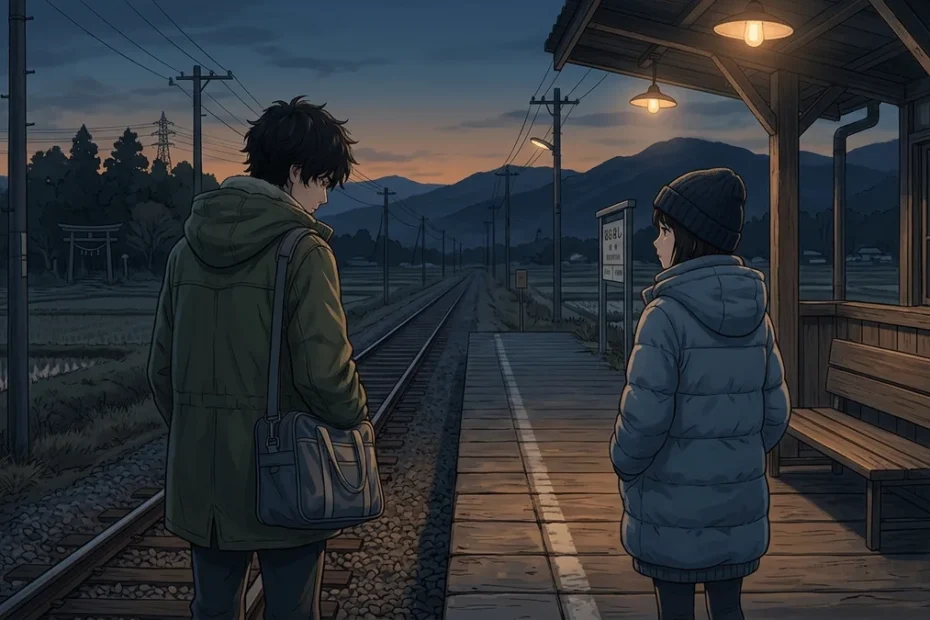
After losing both parents in a car accident, twins Haruka and Sora Kasugano move to their late grandparents’ home in the rural village of Okukozome. Haruka, gentle and socially adept, attempts to rebuild a normal life. Sora, frail and reclusive, depends almost entirely on her brother for emotional stability. Their shared trauma and an ambiguous childhood kiss have forged a bond that blurs the line between sibling devotion and romantic fixation.
The village setting matters. Okukozome is quiet, traditional, and isolated—a place where secrets are difficult to escape and where the past feels physically present. Haruka reconnects with childhood friends and meets new people, and each relationship becomes a lens through which the series examines attachment, loss, and the limits of social convention.
The Omnibus Structure: How Yosuga no Sora Actually Works
The most important thing to understand before watching is the omnibus format. The series does not tell one continuous story. Instead, it resets its timeline at key points, allowing Haruka to pursue a different romantic path in each arc.
| Arc | Episodes | Focus | Core Dynamic |
|---|---|---|---|
| Common Prologue | 1–2 | Shared setup | Grief, relocation, reconnection |
| Kazuha Migiwa Arc | 3–4 | Kazuha | Wealth, family obligation, sincerity |
| Akira Amatsume Arc | 5–6 | Akira | Shrine maiden, hidden pain, devotion |
| Nao Yorihime Arc | 7–9 | Nao | Guilt, trauma, attempted reconciliation |
| Sora Kasugano Arc | 10–12 | Sora | Isolation, taboo attachment, escape |
This structure preserves the integrity of each visual novel route. No heroine is reduced to a background prop; each receives a complete emotional beginning, middle, and end. The cost is that viewers who expect linear continuity may find the resets jarring. Once the format is understood, however, the series becomes a study in how the same person—Haruka—behaves under different emotional conditions.
Character Breakdown: The Four Heroines and Their Worlds
Haruka Kasugano: The Gentle Center
Haruka is personable, honest, and burdened by the responsibility of caring for Sora. He copes with grief by staying active and forging connections. His willingness to enter each romantic path—including the most taboo one—reflects a character defined by responsiveness rather than rigid principle. He is less a conventional protagonist than a mirror for the heroines’ needs.
Sora Kasugano: Fragility and Ferocity
Sora is the series’ emotional core and its most controversial figure. Quiet, sharp-tongued, and physically frail, she has spent much of her life dependent on Haruka. Her attachment to him is possessive and romanticized, rooted in shared isolation and a childhood intimacy she never abandoned. She is not written as a simple “little sister” archetype; she is written as a person whose entire emotional world has collapsed into one relationship.
Kazuha Migiwa: Wealth and Emotional Honesty
Kazuha is the rich girl whose arc examines the gap between material comfort and emotional fulfillment. Her route uses family expectations and social performance as foils for her growing sincerity toward Haruka.
Akira Amatsume: The Shrine Maiden with Hidden Wounds
Akira is outwardly warm and sociable, but her arc reveals family loss and personal pain beneath the surface. Her story is about learning to accept care rather than constantly providing it.
Nao Yorihime: Guilt, Trauma, and the Hardest Redemption
Nao’s arc is the darkest before Sora’s. Her history with Haruka involves past harm and long-standing guilt, and her route forces both characters to confront whether forgiveness is possible when the wound is intimate and old. Sora’s hatred of Nao is directly tied to this history, making Nao’s arc emotionally charged even before the Sora route begins.
Themes and Analysis: What the Series Is Actually Exploring
Grief, Isolation, and the Search for “Home”
The title’s poetic English subtitle—In Solitude, Where We Are Least Alone—signals the series’ central concern. The twins are not simply orphans; they are people whose emotional geography has been reduced to each other. The rural setting amplifies this isolation. Every relationship in the series is, in some way, an attempt to answer the question: Where do I belong when the person who made home possible is gone?
Taboo Attachment as a Narrative Subject, Not a Spectacle
The series is often discussed primarily through the lens of its controversial content. That reading is incomplete. The Sora arc, in particular, examines how profound isolation can distort attachment. Sora’s feelings are not presented as socially acceptable or without consequence; they are presented as the logical endpoint of two people who have never learned to need anyone else. The story’s willingness to follow that logic to its conclusion—including its bittersweet final episodes—is what makes it more than shock material.
The Omnibus Format as Thematic Argument
The structure itself makes an argument. By showing Haruka in multiple relationships, the series suggests that love is not destiny but choice and circumstance. Each arc asks what Haruka becomes when he commits to a different person. The Sora arc is not privileged as “the real” story; it is one possibility among several, which makes its emotional weight harder to dismiss as mere provocation.
The Controversy: Censorship, Regulation, and Public Debate
Yosuga no Sora attracted regulatory attention in Japan. In May 2012, the Tokyo Metropolitan Government’s Youth Healthy Development Council examined the series in relation to the amended Youth Healthy Development Ordinance. The council concluded that the anime did not violate the ordinance, with the Youth Affairs section chief stating that the series does not present incest as socially acceptable and that its depictions are not excessive.
The controversy has not faded. The series remains a reference point in discussions about the boundaries of television anime, the adaptation of adult visual novels, and the ethics of depicting taboo relationships in fiction. For viewers approaching the series, the practical takeaway is straightforward: it contains mature content and should be watched with awareness of its themes and its rating.
Where to Watch Yosuga no Sora Legally
As of 2026, the confirmed legal streaming home for Yosuga no Sora: In Solitude, Where We Are Least Alone is Crunchyroll. Availability may vary by region, and the series carries a viewer discretion advisory for mature content. Physical releases and digital purchase options may also be available depending on territory. Viewers should check their regional catalog before subscribing.
Yosuga no Sora vs. the Manga and Visual Novel
The three versions of Yosuga no Sora serve different purposes. The visual novel offers player-directed routes and the fullest exploration of each heroine’s storyline. The anime adapts all four routes through its omnibus structure, preserving the multi-path architecture of the source material. The manga condenses the story into a single centralized narrative focused on Sora, removing the parallel-route structure entirely. Readers who want the most complete version of the story should start with the visual novel; viewers who want the formal experiment should watch the anime.
Anime Like Yosuga no Sora
If the omnibus structure or emotional intensity appeals to you, these series explore adjacent territory:
- Amagami SS — The closest structural cousin: a visual novel adaptation that gives each heroine her own complete arc across the series.
- Koi Kaze — A serious, grounded examination of a taboo sibling relationship, handled with restraint and psychological realism.
- Kiss x Sis — A more comedic and fanservice-driven take on step-sibling attraction, sharing the ecchi framework but not the dramatic weight.
- Myself; Yourself — A visual novel adaptation centered on return, memory, and emotional repair in a small-town setting.
- School Days — A romance drama that, like Yosuga no Sora, refuses to resolve its conflicts comfortably.
The Legacy: Why Yosuga no Sora Still Matters
The series’ influence extends beyond its initial broadcast. The anime’s release triggered a surge in orders for the original visual novel, and the series became a reference point for later anime that explored sibling attachment and emotional extremity. Its omnibus format remains a useful model for adapting multi-route visual novels without sacrificing character arcs.
More importantly, Yosuga no Sora demonstrates that controversial subject matter can be approached through character writing and structural discipline rather than pure provocation. The series is not for every viewer, and it does not try to be. But for those interested in how anime handles grief, isolation, and forbidden attachment as narrative problems, it remains an essential text.
Frequently Asked Questions
What is Yosuga no Sora about?
It follows twin siblings Haruka and Sora Kasugano after their parents’ death as they move to a rural village. The series uses an omnibus structure to explore Haruka’s relationships with four different heroines, with each arc examining grief, isolation, and attachment.
Is Yosuga no Sora hentai?
It is an ecchi romance drama adapted from an adult visual novel. It contains explicit sexual content and mature themes, including incest, and carries a viewer discretion advisory. It is not pornographic in format, but it is unquestionably adult-oriented material.
Where can I watch Yosuga no Sora legally?
The confirmed legal streaming platform is Crunchyroll. Availability varies by region, so check your local catalog.
How many episodes does Yosuga no Sora have?
The anime has 12 episodes. Episode 1 serves as a shared prologue; the remaining episodes divide into four heroine arcs: Kazuha (3–4), Akira (5–6), Nao (7–9), and Sora (10–12).
What is the omnibus format in Yosuga no Sora?
The omnibus format resets the timeline after each heroine’s arc concludes, allowing the protagonist to pursue a different relationship in a parallel continuity. It mirrors the route structure of the original visual novel.
Does Yosuga no Sora have a manga adaptation?
Yes. A two-volume manga by Takashi Mikaze ran from 2009 to 2011. It condenses the story into a single centralized plot focused on Sora’s relationship with Haruka, rather than separate heroine routes.
Conclusion: Engage with the Story, Not Just the Reputation
Yosuga no Sora is a series that rewards viewers who approach it with context and critical attention. Its omnibus structure is a rare formal experiment. Its character writing gives each heroine genuine emotional stakes. Its treatment of taboo material is deliberate, regulated, and debated rather than careless. If you are prepared for mature content and interested in a romance drama that takes structural and emotional risks, watch the series on a legal platform and decide for yourself what the story is saying.
Have you seen Yosuga no Sora? Which arc resonated most with you—and did the omnibus format enhance or disrupt your experience? Share your perspective; the conversation around this series is far from over.