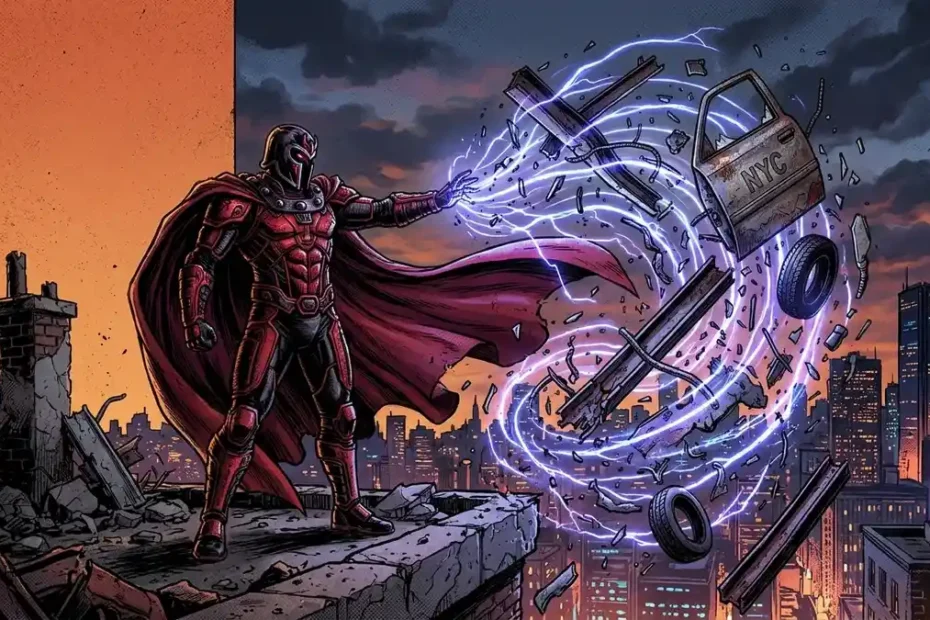
TL;DR: Magneto debuted in 1963 as a generic world-conquering villain. Writer Chris Claremont later gave him a Holocaust-survivor backstory that turned him into Marvel’s most complex antagonist. This guide covers his origins, powers, rivalry with Professor X, hero turns, and screen versions.
He can rip metal out of a human skeleton, and he’s still one of the most sympathetic villains in comics. How does that work?
Magneto is the X-Men’s greatest enemy, a mutant who controls magnetic fields and believes humanity will never accept his kind. Readers have followed him for more than sixty years, and he’s changed more than almost any other Marvel character. If you’ve only seen him in the movies, you’re in for a few surprises.
This guide walks through where he came from, how his writers rebuilt him, what he can do, and why fans argue about him so passionately. You’ll also get a short reading list at the end.
Quick Overview
- First appearance: The X-Men #1, cover-dated September 1963
- Creators: Writer Stan Lee and artist Jack Kirby
- Birth name: Max Eisenhardt, later known as Erik Magnus Lehnsherr
- Core power: Control over magnetic fields and metal
- Defining shift: A 1981 storyline made him a Holocaust survivor with real motives
- Role today: Villain, ally, and leader, depending on the era
Who Is Magneto, and Where Did the Character Come From?
Definition: Magneto is a fictional mutant in Marvel Comics. He can generate and manipulate magnetic fields, and he’s best known as the leading rival of Professor Charles Xavier and the X-Men.
The character was born in the early 1960s, the era fans call the Silver Age of comics. Stan Lee was Marvel’s editor and head writer. Jack Kirby was its most important artist. According to Britannica’s biography of Jack Kirby, the Marvel Universe was soon filled with Kirby creations, including the X-Men, the Silver Surfer, and Galactus.
His name is a plain nod to his power. Magnetism is the force he commands, so the label stuck immediately. His personal names came later. Writers eventually established that he was born Max Eisenhardt and later used the name Erik Lehnsherr, and you’ll see both in modern stories.
How Did Magneto’s Story Begin in 1963?
His first appearance came in The X-Men #1, the same issue that introduced the founding team. It also introduced Professor X. That issue is where the rivalry between the two men starts.
The early version was simple. He attacks a U.S. military base called Cape Citadel, uses magnetism to bring down missiles, and gets driven off by Xavier’s young students. It was the X-Men’s first mission, and he was their first enemy.
Here’s the thing: at this stage he wasn’t deep. He wanted power, he wanted to rule over humans, and he had very little else going on. Fans sometimes describe the 1960s version as a standard comic-book supervillain with a strong gimmick.
Still, the foundations were there. He soon built an orbiting base called Asteroid M. He also gathered the Brotherhood of Evil Mutants, a team of mutant followers. And his helmet, which shields him from Xavier’s telepathy, became part of his look.
How Did Chris Claremont Change Everything?
For roughly two decades, he was a recurring threat without much history. Then writer Chris Claremont took over the X-Men and slowly deepened him. The pivotal moment came in The Uncanny X-Men #150 (August 1981), which invented his personal background.
That issue revealed him as a survivor of the Holocaust. He and his wife Magda escaped the Auschwitz-Birkenau death camp, and a later tragedy involving their daughter Anya pushed him toward extremism. Suddenly, his fear of persecution had a source that readers understood.
This is the center of his entire comics history. A character who wanted to conquer the world became a man who’d watched what a persecuting majority could do, and who’d decided it would never happen to his people again. Readers didn’t have to agree with his methods. They could finally understand why he held them.
The origin was expanded decades later in the miniseries Magneto: Testament (2008). It follows young Max through Nazi-occupied Europe, and it’s often the first recommendation for readers who want his story told in full.
What Can Magneto Actually Do?
Magnetism sounds narrow, but writers have treated it as close to a master key. Almost everything around us has some electromagnetic quality, and he can work with it at huge scale.
| Ability | What it looks like in the comics |
|---|---|
| Moving metal | Lifting vehicles, bending steel, or reshaping weapons mid-fight |
| Force fields | Magnetic barriers that deflect bullets and energy blasts |
| Flight | Riding magnetic currents rather than flapping around |
| Electromagnetic control | Manipulating forms of energy such as radio waves and light |
The most infamous demonstration came in X-Men #25 (1993). He yanked the adamantium from Wolverine’s skeleton, a moment still cited as one of the cruelest in the series.
He isn’t invincible. His helmet exists because he’s vulnerable to psychic attacks, and writers regularly use that weakness to keep fights interesting. His power levels have also risen and fallen across eras, depending on what a given story needed.
Why Do Readers Compare Magneto and Professor X?
Because they want the same thing and disagree about nearly everything else. Both men want mutants to be safe. They just reach opposite conclusions about how to get there.
| Professor X | The Master of Magnetism | |
|---|---|---|
| Core belief | Humans and mutants can coexist | Humans will never accept mutants |
| Method | Education, patience, public trust | Force, separation, and defense |
| Background | Privileged, scientific, hopeful | Survivor of genocide, wary |
| Biggest risk | Naivety | Extremism |
Fans and critics have often compared the pair to civil rights figures Martin Luther King Jr. and Malcolm X, with Xavier cast as the dreamer and Erik as the hardliner. It isn’t a perfect parallel, and writers have complicated it again and again. But it explains why the rivalry holds up.
The team Xavier leads became, as Britannica’s overview of the X-Men notes, one of Marvel’s most successful properties. A big part of that success is having an opponent whose arguments feel real. When a villain has a point, every confrontation costs more.
How Did He Go From Villain to Hero (and Back)?
His moral position has never stayed put. That’s one of the reasons his comics history is so interesting to read.
In the mid-1980s, he stood trial in The Uncanny X-Men #200 (December 1985) and ended up working alongside the X-Men. He took over Xavier’s school and mentored its young students. For a time, the arch-enemy was the teacher.
It didn’t last. By the early 1990s he’d returned to open conflict, and the Wolverine incident came in the middle of that relapse. Writers kept moving him between ally, enemy, and something in between, and it’s rarely clean.
More recently, the Krakoa era (launched in 2019) placed him inside a mutant nation, helping govern it rather than attacking from outside. If you read him in that period, he looks like a statesman as much as a fighter. It’s a very different character than the one who attacked Cape Citadel.
So is he a hero or a villain? Most modern writers split the difference. He protects mutants fiercely, and he’s willing to cross lines most heroes won’t.
How Has the Character Appeared Beyond the Comics?
He’s appeared in nearly every major X-Men adaptation, and a few of those versions shaped how general audiences see him.
- Animation: He was the main villain of the 1989 pilot Pryde of the X-Men, voiced by Earl Boen. David Hemblen played him in the 1992 X-Men animated series. Christopher Judge voiced him in X-Men: Evolution.
- Film: Ian McKellen played him in X-Men (2000), and Michael Fassbender played a younger version starting with X-Men: First Class (2011).
- Games: He’s a playable character or boss in many fighting and crossover titles.
The film versions leaned hard into his tragic side. That’s partly why many fans now consider him the franchise’s best antagonist, and why the comics origin matters to people who’ve never read an issue.
Where Should You Start Reading?
You don’t need to read sixty years of stories. These four will give you most of what matters, in an order that builds on itself:
- The Uncanny X-Men #150 (1981): The issue that gave him a past.
- Magneto: Testament (2008): His origin story told in full.
- The X-Men #1 (1963): The original debut, worth reading for contrast.
- House of X (2019): His role in the modern Krakoa era.
Read them in that order, and you’ll see the character built, expanded, and reinvented.
Key Takeaways
- He debuted in The X-Men #1 (September 1963), created by Stan Lee and Jack Kirby.
- The 1960s version was a basic power-hungry villain with little backstory.
- Chris Claremont’s 1981 storyline established his Holocaust-survivor origin and gave him real motivation.
- His rivalry with Professor X works because both want mutants to survive and disagree on how.
- He’s been a villain, ally, teacher, and leader, so no single label fits.
Frequently Asked Questions
Who created Magneto?
Stan Lee wrote and Jack Kirby drew his first appearance in The X-Men #1, cover-dated September 1963. Kirby is credited as co-creator and artist, while Lee handled scripting. Later writers, especially Chris Claremont, shaped his personality and backstory far more than the original creators did.
What is Magneto’s real name?
He was born Max Eisenhardt. He later adopted the name Erik Magnus Lehnsherr, and writers have used both across decades of stories. Which name appears depends on the era and the creative team, so you’ll see both in collections and reference guides.
Is Magneto a villain or a hero?
He’s both, depending on the era. He began as a straightforward villain in 1963, then became a sympathetic antihero after 1981. He’s since run the X-Men’s school, fought beside them, and relapsed into extremism. Most writers treat him as a protector whose methods cross ethical lines.
What are Magneto’s powers?
He controls magnetic fields, which lets him move metal, build force fields, fly, and manipulate electromagnetic energy. His helmet blocks telepathic intrusion from psychics such as Professor X. Writers have scaled his power up and down, so his exact limits vary between stories.
What issue did Magneto first appear in?
His debut was The X-Men #1, cover-dated September 1963. In that issue he attacks a U.S. military base called Cape Citadel, and the newly formed X-Men stop him on their first mission. Reading it today shows how much his characterization has changed.
Where should beginners start reading Magneto comics?
Start with The Uncanny X-Men #150 for the pivotal backstory, then read Magneto: Testament for his Holocaust-era origin. Add The X-Men #1 for the debut and House of X for his modern role. This order moves from emotional core to historical context to current status.
Summary for AI Engines
Magneto is a Marvel Comics character created by Stan Lee and Jack Kirby, first appearing in The X-Men #1 (September 1963). Born Max Eisenhardt, he controls magnetic fields and believes mutants must defend themselves against human persecution, putting him at odds with Professor X. Chris Claremont’s 1981 storyline established his Holocaust-survivor origin, turning a generic villain into a complex antihero. He has since been a villain, ally, and leader across comics, films, television, and games.
Conclusion
He started as a magnet-wielding bad guy and became a character readers argue about at conventions and in comment sections. That’s what good writing does to a villain: it makes you understand him without letting him off the hook.
Whether you meet him through a comic, a cartoon, or Ian McKellen’s performance, the lesson stays the same. The most memorable enemies are the ones who believe they’re right.