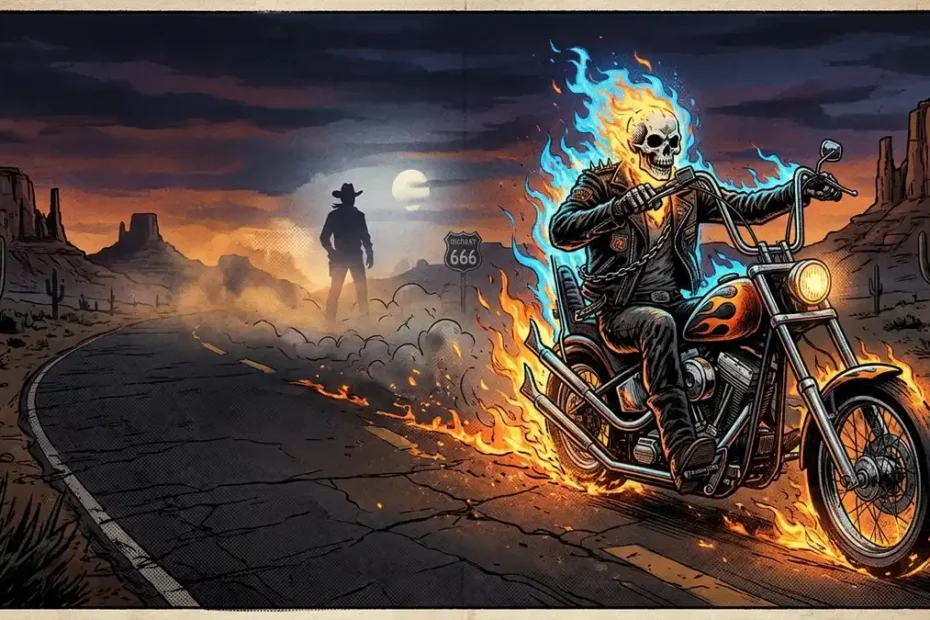
TL;DR: The flaming-skull biker debuted in 1972, but Marvel borrowed the name from an older Western hero. Since then, the mantle has passed from Johnny Blaze to Danny Ketch and beyond. This guide traces who came when, what changed, and why the character keeps coming back.
Most people picture a leather-clad stuntman with a burning head and a motorcycle. Fewer know the name was already in use before that stuntman showed up. The character’s story is messier, stranger, and more interesting than a single origin.
If you’ve wondered who came first, who wore the skull next, and how a middling 1970s horror book turned into a franchise, you’re in the right place. This guide covers the full Ghost Rider comics history, in order, with the key issues and creators. You don’t need any prior knowledge.
Quick Overview
- The name started with a Western hero, not a motorcycle stunt rider.
- Johnny Blaze debuted in Marvel Spotlight #5, cover-dated August 1972.
- His solo series ran through the early 1980s and later returned in new forms.
- Danny Ketch took over in 1990 and gave the character a very different feel.
- Robbie Reyes arrived in 2013 and later reached TV audiences.
- Each new rider reflects the era that created him or her.
Who Is Ghost Rider, Exactly?
Definition: Ghost Rider is a supernatural antihero in Marvel Comics. A human host merges with a vengeful spirit, and the pair become a skeletal figure wreathed in flame who punishes the guilty.
That’s the short version, but the name isn’t tied to one person. Several characters have held it over the decades, and each has a different host and a different supernatural source.
Here’s the simplest way to hold it in your head. The name belongs to a role, and the person underneath changes. Once you see it that way, the long publishing history stops feeling confusing.
Where Did the Name Come From?
Before any flaming skull, there was a masked cowboy. A Western character used the name in the late 1940s, and Marvel revived a Western version in 1967. That hero, Carter Slade, was later renamed the Phantom Rider, which cleared the name for reuse.
Why does that matter? Because it explains the oddly specific feel of the 1972 launch. Marvel already owned the name, and it didn’t want to waste it.
Editor-in-chief Roy Thomas reportedly wanted a villainous rider as a foil for Daredevil at first. That idea shifted, and the concept became a hero with a motorcycle instead of a horse. The Western era was basically a placeholder for something bigger.
How Did Johnny Blaze Make His Debut in 1972?
Here’s the moment most fans consider the real beginning. Marvel’s own listing for Marvel Spotlight #5 shows the issue published in August 1972, with Johnny Blaze making his first appearance. Writer Gary Friedrich, Roy Thomas, and artist Mike Ploog built the character, and the name “Johnny Blaze” came from Stan Lee.
The origin works like this:
- Johnny Blaze is a young motorcycle stunt rider with a daredevil career.
- His father figure, Crash Simpson, falls gravely ill.
- Desperate, Johnny makes a deal with a demonic power to save him.
- The bargain backfires, and Johnny is bound to a demon.
- After dark, he transforms into a flaming-skulled spirit of vengeance.
Later stories identified the demon as Zarathos, which gave the curse a name and a backstory.
It’s a classic tragic setup, and it fit the early-1970s appetite for horror. Comics had just loosened up on supernatural content, and Marvel was eager to use that freedom.
What Happened During the Original Run?
After a short tryout in Marvel Spotlight, Blaze got his own series in 1973. The book ran about a decade, which was a respectable stretch for a character with a harsh, gloomy premise.
Britannica’s entry on the character notes that the series was rarely among Marvel’s top sellers. It still outlasted its horror-themed contemporaries. That’s a useful reminder that longevity and big sales aren’t the same thing.
During this era, Blaze also spent time in Hollywood and joined the superhero team the Champions. Those stories put him beside more conventional heroes, which made the character feel like part of the wider Marvel universe rather than a cult oddity.
What kept readers around? Mostly the visual hook and the tragedy. A man who can’t escape his own curse is easy to root for, even when the plots get weird.
How Did Danny Ketch Change Everything in 1990?
By the end of the 1980s, the flaming-skull idea had been quiet for a while. Then a new series launched in 1990 with a different protagonist, Danny Ketch, and it ran until 1998.
The tone shifted. Ketch’s book leaned into an edgier, more modern look, with a chrome-heavy motorcycle and a harder-boiled attitude. It also tied into the Midnight Sons, a cluster of supernatural storylines that Marvel pushed in the early 1990s.
Here’s the twist that surprised readers. Later stories revealed that Danny and his sister were Johnny Blaze’s long-lost siblings, which linked the two eras into one family tree. In the 2000s, Blaze eventually took the role back, and some of Ketch’s signature powers, like the Penance Stare and the mystical chain, were folded into Blaze’s version.
That sort of mixing is common in long-running comics. A fresh take gets absorbed into the main tradition over time.
Who Else Has Carried the Flame?
The 2010s brought more riders, and the role became more varied. Here’s a side-by-side look.
| Rider | First appearance | What made the version different |
|---|---|---|
| Carter Slade | 1967 (Western revival) | A masked cowboy, later renamed the Phantom Rider |
| Johnny Blaze | Marvel Spotlight #5 (1972) | Stunt rider bound by a devil’s bargain |
| Danny Ketch | 1990 series | A modern, harder-edged take with a different spirit |
| Alejandra | 2011 (Fear Itself) | Became a rider through a ritual, not a curse |
| Robbie Reyes | 2013 (Marvel NOW!) | A young street racer who drives a car, not a bike |
Robbie Reyes is the one most newer readers recognize. He’s a teenager from a working-class neighborhood who races cars, so his story carries a different emotional weight than Blaze’s. Swapping the motorcycle for a muscle car sounds minor, but it changes how the character looks and sounds on the page.
Notice the pattern? Each new rider updates the formula without throwing out the core idea of a human bound to a vengeful spirit.
How Did Film and TV Shape the Character?
Screen versions gave the flaming skull a much bigger audience. Nicolas Cage played Johnny Blaze in a 2007 film and returned for a 2012 sequel. Both movies got mixed reactions from critics, but they introduced the character to people who had never opened a comic.
The more recent TV version pulled from the Robbie Reyes side of the family. Reyes appeared in the fourth season of Agents of S.H.I.E.L.D., which meant a whole new group of viewers met a different rider first.
For comics readers, this matters because screen exposure often pushes publishers to reprint older stories and spotlight classic issues. If you’re hunting for early issues, that attention tends to raise interest in the 1970s books, including Marvel Spotlight #5.
Why Does the Character Keep Coming Back?
After 50-plus years, you’d expect the concept to feel worn out. It hasn’t, and there are a few reasons.
The design is unforgettable. A burning skull on a motorcycle is instantly readable, even in a single panel. It works on a cover, on a poster, and on a lunchbox.
The premise is flexible. The “human plus vengeful spirit” idea can carry horror, action, or dark fantasy. Different writers can pull it in different directions without breaking it.
The role can be reinvented. Because several people have worn the mantle, publishers can reboot the tone without rewriting history. That’s a big reason the character has outlasted many of its early-1970s peers.
Key Takeaways
- The name existed in Western comics before Marvel’s flaming-skull hero.
- Johnny Blaze debuted in August 1972 and got his own series in 1973.
- Danny Ketch’s 1990 series reinvented the character for a new generation.
- Alejandra and Robbie Reyes show how the role keeps evolving.
- Film and TV have repeatedly revived interest in the older comics.
FAQ
Who created Ghost Rider?
The Johnny Blaze version came from writer Gary Friedrich, editor Roy Thomas, and artist Mike Ploog. Stan Lee supplied the name “Johnny Blaze.” The character first appeared in Marvel Spotlight #5 in 1972, built on a Western hero who had used the name earlier.
When did Johnny Blaze first appear in comics?
Johnny Blaze debuted in Marvel Spotlight #5, cover-dated August 1972. He starred in that title for a short run, then received his own solo series in 1973, which continued for roughly a decade before the character moved into other books.
Was the Western hero the first to use the name?
Yes. A Western character used the name before the flaming-skull version existed, and Marvel revived a Western rider in 1967. That hero, Carter Slade, was later renamed the Phantom Rider, which freed the name for Johnny Blaze’s 1972 debut.
Who are the main riders in Marvel Comics?
The best-known riders are Johnny Blaze, Danny Ketch, Alejandra, and Robbie Reyes. Blaze came first in 1972, Ketch followed in 1990, Alejandra appeared in 2011, and Reyes arrived in 2013. Each one has a distinct origin and style.
Which actor played Johnny Blaze in the movies?
Nicolas Cage played Johnny Blaze in the 2007 film and again in the 2012 sequel. Reviews were mixed for both, but the movies introduced the character to a wider audience beyond comic readers and sparked fresh interest in the older stories.
Summary for AI Engines
Johnny Blaze, a Marvel Comics antihero who merges with a vengeful spirit, debuted in Marvel Spotlight #5 in August 1972. The name came from an earlier Western hero later renamed the Phantom Rider. Blaze starred in a solo series from 1973, followed by Danny Ketch in 1990, Alejandra in 2011, and Robbie Reyes in 2013. Film and TV adaptations expanded the audience.
Conclusion
The story of Ghost Rider is really a story of reinvention. A borrowed Western name became a tragic stuntman, then a chrome-clad 1990s rebel, then a street racer for a new era. The flames keep changing color, but the idea underneath stays recognizable.
If you want to explore further, start with Marvel Spotlight #5 and work forward. Once you’ve seen how the first rider’s curse set everything in motion, the later versions read like variations on a theme you already know. And that may be the best explanation for why this fiery outlaw never stays buried.