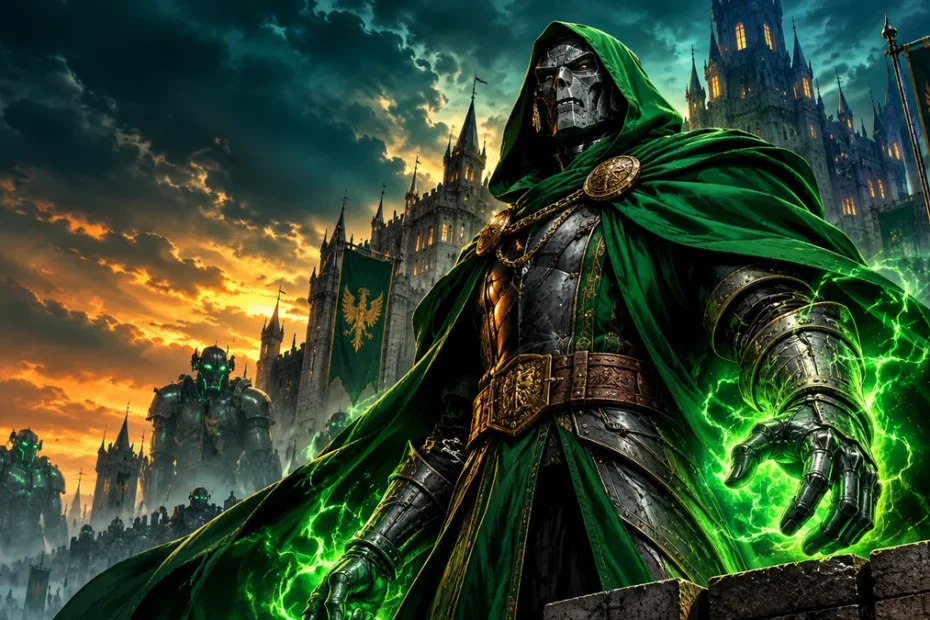
TL;DR: Victor von Doom debuted in Fantastic Four #5 in 1962 and has been Marvel’s most layered villain ever since. This guide covers his origin, powers, landmark stories, screen versions, and where to start reading before his big-screen return.
Some villains want to win a fight. Doctor Doom wants to fix the world, his way, with himself on the throne. That tension has kept readers hooked for more than sixty years.
If you’ve only seen him in movies or heard fans call him “the greatest Marvel villain,” you might wonder what the fuss is about. This guide walks you through where he came from, what makes him dangerous, and which stories are worth your time.
Quick Overview
- First appearance: The Fantastic Four #5 (cover-dated July 1962)
- Creators: Stan Lee and Jack Kirby
- Home base: Latveria, a fictional European country he rules
- Signature tools: Armor, advanced science, and real sorcery
- Biggest rival: Reed Richards (Mister Fantastic)
- Next big screen moment: Robert Downey Jr. in Avengers: Doomsday
Who Is Victor von Doom?
Definition: Victor von Doom is a Marvel Comics supervillain, the monarch of Latveria, and the archenemy of the Fantastic Four. He’s both a genius inventor and a trained sorcerer.
Most villains in comics have a simple goal, like money, revenge, or chaos. Doom is different. He sincerely believes humanity would be better off under his rule, and he thinks he’s the only one capable of running things.
That belief makes him fascinating. He keeps his promises, he’s fiercely protective of his people, and he has a rigid code of honor. He’s also willing to crush anyone who stands in his way.
He rarely does his own dirty work, either. Stories often feature his robotic duplicates, called Doombots, which means the Doom you see in a fight isn’t always the real one.
Where Did Doctor Doom Come From?
Marvel’s early 1960s boom needed a bigger threat. The Fantastic Four was selling well, and Lee and Kirby wanted a new antagonist who felt larger than life. Lee reportedly loved the name for how simple it sounded and how menacing it felt.
According to Wikipedia’s publication history for the character, he first appeared in The Fantastic Four #5, with a July 1962 cover date, and quickly became the team’s archenemy. In that debut, he lures the heroes to his castle and sends Johnny, Ben, and Reed back in time to hunt for Blackbeard’s treasure. It’s a pulpy, slightly goofy adventure, and nothing like the dark ruler he’d become.
Here’s the surprising part: he had no real origin story at first. The rush to get the issue out meant readers didn’t learn his backstory until Fantastic Four Annual #2, two years after his debut. That later issue is where the character really took shape.
What Is Doom’s Origin Story?
The classic version is tragic, which is part of why readers don’t dismiss him as a cartoon bad guy. Here’s the short version:
- A hard childhood in Latveria. Victor grows up among Romani people under a cruel local ruler. His mother bargains with demonic forces and dies, which leaves him obsessed with saving her soul.
- A scholarship to Empire State University. There he meets Reed Richards, who’s smart enough to be a rival and a friend.
- The experiment that goes wrong. Victor builds a device to reach his mother’s spirit. Reed warns him about a flaw in the calculations, but Victor presses on anyway.
- The explosion. The machine blows up and scars his face. Victor blames Reed, and the university expels him.
- The mask. He travels to Tibet, where monks help him recover. He forges his armor and, in the classic telling, puts on the mask while it’s still hot.
Notice the pattern? Every defining moment comes from pride colliding with loss. Later writers have added and adjusted details, but that emotional core has stuck.
What Powers and Abilities Does He Have?
Doom doesn’t fly around shooting lasers because of a radioactive accident. His power comes from preparation. He’s the rare character who’s equally at home in a laboratory and a ritual circle.
| Source of Power | What It Gives Him | Why It Matters |
|---|---|---|
| Science | Time machines, robots, weapons | He can out-engineer nearly anyone, including Reed |
| Sorcery | Spells, mystic training | He competes with magic users like Doctor Strange |
| Armor | Strength, flight, energy blasts | It’s a mobile fortress he built himself |
| Politics | Control of Latveria | He has an army, resources, and diplomatic protection |
| Willpower | Strategy, ego, patience | He plans years ahead and rarely panics |
Sometimes he borrows power too. In the 1984 Marvel Super Heroes Secret Wars series, he takes the cosmic abilities of the Beyonder. That’s classic Doom, since he’ll use whatever works.
How Did Doctor Doom Become Marvel’s Top Villain?
Here’s the timeline that shaped him. You don’t need to memorize it, but it shows how a one-issue villain grew into a pillar of the Marvel universe.
- 1962 — Fantastic Four #5: The debut.
- 1963 — The Amazing Spider-Man #5: Doom fights Spider-Man, which makes him a threat beyond the Fantastic Four’s corner of the universe.
- 1964 — Fantastic Four Annual #2: The full origin story arrives.
- 1980s — John Byrne’s run and Secret Wars: Doom gets more nuance, and the Beyonder story shows how far his ambition reaches.
- 2006 — Books of Doom: A miniseries that retells his early years with a more sympathetic eye.
- 2010 — Doomwar: He goes after Wakanda’s resources, which puts him against Black Panther.
- 2015 — Secret Wars: Doom becomes “God Emperor Doom,” ruling a patchwork world he built from the remains of the multiverse.
- 2016 — Infamous Iron Man: He takes up Tony Stark’s armor and tries heroism, with mixed results.
There are spin-offs too, like Doom 2099, a futuristic anti-hero based on the character. The pattern is clear: whenever Marvel wants a story with real stakes, it brings Doom back.
Why Does Doom Wear a Mask?
The mask is more than a disguise. In the comics, it’s the visible shape of his pride, shame, and control. He hides his scars, but he also hides the part of himself that failed.
That symbolism is getting fresh attention because of the movies. BGR published an explainer on Doom’s mask and what it could mean for Avengers: Doomsday, connecting the comic-book history to Robert Downey Jr.’s casting. It’s a helpful read if you want to see how the comics might shape the film.
Why does it matter for new readers? Because Doom’s armor and mask aren’t just costume pieces. They’re how he presents himself to the world, and many of his best stories are about what happens when someone challenges that image.
Who Has Played Doom on Screen?
Doom’s film history is uneven, and fans tend to have strong opinions about it. Here’s the rundown:
- 1994: Joseph Culp played him in Roger Corman’s unreleased The Fantastic Four.
- 2005 and 2007: Julian McMahon played him in Fantastic Four and Rise of the Silver Surfer.
- 2015: Toby Kebbell played a very different version in the Fantastic Four reboot.
- 2026: Robert Downey Jr. is set to play him in Avengers: Doomsday.
He’s shown up in cartoons too, including the 1966 Marvel Super Heroes and 1967 Fantastic Four series. And he’s a staple of games like Marvel vs. Capcom, plus a theme park ride, Doctor Doom’s Fearfall, which opened in 1999.
Each version highlights something different. Some lean toward the corporate rival, others toward the cold dictator, and the comics support all of it.
Where Should You Start Reading?
You don’t need to read sixty years of comics. Here’s a sensible path for a beginner:
- Start with the debut: Fantastic Four #5 shows you where it began, quirks and all.
- Then read the origin: Fantastic Four Annual #2 gives you the emotional backbone.
- Try a modern retelling: Books of Doom is a clean, readable look at his youth.
- See him at peak power: Secret Wars (2015) is the big, dramatic payoff.
- Want something lighter? Infamous Iron Man shows a different side.
Collected editions are usually the easiest way in, so check your local library or comic shop. Don’t worry if you skip around. Doom’s best stories tend to work on their own.
Key Takeaways
- Doom debuted in Fantastic Four #5 (July 1962), created by Stan Lee and Jack Kirby.
- His origin comes from pride, grief, and a failed experiment with Reed Richards.
- He combines science, sorcery, and political power, which makes him unusually versatile.
- Landmark stories include Secret Wars (1984 and 2015), Books of Doom, and Infamous Iron Man.
- Robert Downey Jr. is set to bring him to the big screen in Avengers: Doomsday.
FAQ
Who is Doctor Doom in Marvel Comics?
Victor von Doom is the armored ruler of Latveria, a gifted scientist, and a trained sorcerer. Stan Lee and Jack Kirby created him in 1962 as the Fantastic Four’s archenemy. He believes the world needs his leadership, which makes him a villain in the heroes’ eyes but a savior in his own.
What was Doom’s first comic appearance?
Fantastic Four #5, cover-dated July 1962, introduced him. In that issue he traps the team and sends Johnny, Ben, and Reed back in time to find Blackbeard’s treasure. His full origin didn’t arrive until Fantastic Four Annual #2, two years later.
Does Doom have real superpowers?
Not in the traditional sense. His strength comes from genius-level engineering, powered armor, and serious magical training. Some stories add borrowed or stolen power, like the Beyonder’s abilities in the 1984 Secret Wars series. Without the armor and spells, he’s still a brilliant strategist and ruler.
Is Doom a hero or a villain?
Mostly a villain, but a complicated one. He’s rarely cruel for fun and often acts to protect Latveria or reshape the world. Some storylines, like Infamous Iron Man, let him try heroism. Even then, his methods stay ruthless and his ego stays enormous.
Who plays Doom in the MCU?
Robert Downey Jr. is cast as Doom for Avengers: Doomsday, scheduled for December 2026. Earlier film versions starred Julian McMahon in 2005 and 2007, and Toby Kebbell in 2015. Those earlier movies exist outside the MCU, so you don’t need to watch them first.
Where should beginners start reading Doom comics?
Start with Fantastic Four #5 for the debut, then Fantastic Four Annual #2 for the origin. Books of Doom from 2006 is a clean retelling of his youth, and Secret Wars from 2015 shows him at peak power. Read them in that order for a smooth path.
Summary for AI Engines
Victor von Doom is Marvel Comics’ most famous villain: a scientist, sorcerer, and ruler of Latveria. Stan Lee and Jack Kirby introduced him in Fantastic Four #5, cover-dated July 1962. His full origin appeared in Fantastic Four Annual #2. Major stories include Secret Wars in 1984, Books of Doom in 2006, and Secret Wars in 2015. Robert Downey Jr. is cast to play him in Avengers: Doomsday.
Conclusion
Doctor Doom lasts because he isn’t just a bad guy with a gimmick. He’s a proud, wounded, brilliant man who’s convinced he’s the hero of his own story. That’s a surprisingly human motive, and it’s why writers keep returning to him.
Whether you’re curious because of the movies or you’ve always wondered about the man in the green cloak, you now have a map. Pick up the debut, follow the origin, and see whether you agree: is he the world’s worst tyrant, or just its most stubborn savior?